
Unit 9 Uneven development on a global scale
9.3 Capital goods and technology
- production function
- A production function is a graphical or mathematical description of the relationship between the quantities of the inputs to a production process and the amount of output produced. When used to represent output in the whole economy, it is described as an aggregate production function.
- labour productivity, productivity of labour
- A measure of the effectiveness of the labour input in a production process. Typically it is total output divided by the number of units of labour (e.g. hours, or workers) used to produce it, or in other words the average product of labour.
To think about how and why a country’s income and living standards may grow over time, we can start with the aggregate production function, which summarizes how the inputs to production are converted into aggregate output (and income). In the macroeconomic model of the economy developed in Units 1 to 3, we use the simplifying assumptions that labour is the only input, and output per worker, \(\lambda\), is fixed. The production function is \(Y=\lambda N\), where \(Y\) is output and \(N\) is total employment. In that scenario, output can only increase if either more workers are employed, or labour productivity, \(\lambda\), increases—for example, due to an improvement in the quality of education and training. Section 2.4 shows how this affects output, unemployment, and inequality.
For a fuller picture of how the economy changes, we need to include other factors of production. How much output is produced also depends on inputs such as:
- capital equipment, such as tools (including digital ones), machines, and buildings
- energy: coal, oil, gas, or renewable energy such as wind and solar
- land
- other environmental resources, such as water, forests, or minerals
- public infrastructure, such as roads, railways, and digital networks.
And it depends on the technologies used to convert inputs into outputs.
The production function: Labour, capital goods, and technology
- capital goods, capital
- Capital goods (sometimes shortened to ‘capital’) are the durable and costly non-labour inputs used in production (e.g. machinery, equipment, buildings). They do not include some essential inputs (e.g. air, water, knowledge) that are used in production at zero cost to the user.
Initially we will imagine that there are just two inputs: capital (\(K\)) and labour (\(N\)). We could then write the production function as \(Y = F(K, N)\), and think of the function \(F\) as the production technology: using this technology, different amounts of \(K\) and \(N\) are combined to produce output. However, we also want to allow for technological change. So instead, we will write the production function as:
\[Y = z F(K, N)\]- total factor productivity, TFP
- In a production process, if the amount of output that can be produced increases, without any changes in the factors of production (inputs) we say that total factor productivity (TFP) has increased. For example, if the inputs are capital (\(K\)) and labour (\(N\)), we can write the production function as \(Y = zF(K,N)\), where \(z\) represents TFP.
where \(z\) represents the current state of technology. Technological progress causes \(z\) to increase, meaning that more output can now be produced using the same amounts of capital and labour as before. We say that total factor productivity has risen. For example, if \(z\) increases by 1% but \(K\) and \(N\) remain constant, the economy produces 1% more output (it grows by 1%).
With this production function, there are three reasons the economy may grow: technological progress (an increase in \(z\)), capital accumulation (\(K\) increases), and employment growth (\(N\) increases). The labour input could rise as a result of an increase in labour force participation, for example, or a rise in the number of migrant workers.
For the aggregate economy it is reasonable to assume that, at a given state of technology, if all inputs to production increase in the same proportion, output will do the same. For example, if the labour force doubles, and so do the number of factories where the workers are employed and the number of machines that they use, then the economy will produce twice as much. In other words, the function \(F\) has constant returns to scale.
An increase in \(z\) raises output in the same proportion, but what about a rise in capital equipment, \(K\)? What happens, for example, if \(K\) increases but \(z\) and \(N\) stay constant? With a constant returns technology \(F(K, N)\), we can answer this question by focusing on output per worker, \(Y/N\)—in other words, labour productivity:
Constant returns technology
- capital intensity
- The capital intensity of a production process is the amount of capital used for each unit of labour employed. So if output is produced using \(K\) units of capital and \(N\) workers, the capital intensity is measured by \(K/N\).
With a constant returns technology, \(Y=z F(K, N)\), and holding \(z\) constant, output per worker (\(Y/N\)) depends only on capital per worker, \(K/N\), whatever the level of employment. \(K/N\) measures the capital intensity of production.
Output per worker is: \(\frac{Y}{N} = z \frac{1}{N} F(K,N)\).
With constant returns: \(\frac{1}{N}F(K,N)=F(\frac{1}{N} K, \frac{1}{N} N)\).
Hence \(\frac{Y}{N} = zF(\frac{K}{N}, 1)\)
When \(z\) is constant, this is a function of \(\frac{K}{N}\) only.
Charlie Chaplin showed in the 1936 film Modern Times that there is a limit to the number of machines a worker can make use of.
When \(K\) rises but \(N\) doesn’t change, capital per worker—the number of machines operated by each worker, say—increases. We would expect output to rise, but by less than the increase in \(K/N\): for example if workers now operate double the number of machines, they spend less time with each one, so the amount of output does not double. And as \(K/N\) rises further, extra equipment has less and less effect: workers are too busy operating the equipment they already have to make good use of the new ones.
Note that \(\text{APK} = \frac{Y}{K} = \frac {\frac{Y}{N}}{\frac{K}{N}}\).
- average product
- The average product of an input is total output divided by the total amount of the input. For example, the average product of a worker (also known as labour productivity) is total output divided by the number of workers employed to produce it.
Figure 9.4 shows the relationship between output per worker (\(Y/N\)) on the vertical axis and capital equipment per worker (\(K/N\)) on the horizontal axis—that is, the production function per worker. At point A, each worker operates equipment costing $16,000, and produces $12,800 of output. The average product of capital (APK) is \(12,800/16,000 = 0.8\). At B, capital per worker is more than twice as high ($36,000), and output has risen—but only to $19,200, so the productivity of capital is much lower: \(\text{APK} = 0.53\).
The APK at B is shown on the diagram: it is the slope of the line from the origin to B. It is clear without doing any calculations that it is lower than the APK at A—the line from the origin gets flatter as you move along the production function. The curved shape of the production function captures the ‘Charlie Chaplin’ property: as capital intensity, \(K/N\), increases, the average product of capital diminishes.
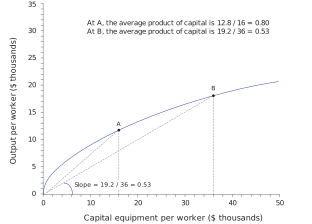
Figure 9.4 The production function: capital productivity falls as capital intensity rises.
As a result of the diminishing APK, an economy will not be able to sustain growth in output per worker simply by adding more of the same type of capital. Eventually, the productivity of capital becomes so low that it is not worth investing any further, given the current state of technology.
Technological progress
- innovation rent
- Profits in excess of the opportunity cost of capital that an innovator gets by introducing a new technology, organizational form, or marketing strategy.
- creative destruction
- Joseph Schumpeter’s name for the process by which old technologies and the firms that do not adapt are swept away by the new, because they cannot compete in the market. In his view, the failure of unprofitable firms is creative because it releases labour and capital goods for use in new combinations.
But technological change that increases the productivity of capital allows sustained economic growth. Firms have incentives to develop and adopt new technologies: they can earn innovation rents by adopting them ahead of their rivals. Firms that fail to innovate (or copy other innovators) are unable to sell their product for a price above the cost of production, and eventually fail. Unit 2 in the microeconomics volume explains how this process of creative destruction has led to sustained increases in living standards. Technological progress and the accumulation of capital goods are complementary: each provides the conditions necessary for the other to proceed.
- New technologies require new machines: The accumulation of capital goods is a necessary condition for the advance of technology, as in the case of the spinning jenny, for example.
- Technological advance is required to sustain the process of capital goods accumulation: It means that the introduction of increasingly capital-intensive methods of production continues to be profitable.
Figure 9.5 illustrates the effect of a technological improvement—modelled as an increase in \(z\). This rotates the production function upwards. Each worker produces more output for a given level of capital equipment—the productivity of capital rises. (Specifically, in this example, output rises by 50% at each level of capital.)
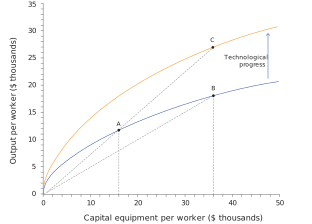
Figure 9.5 Technological progress combined with investment raises output while maintaining capital productivity.
For example, starting at point A with $16,000 capital per worker and APK of 0.75, adopting the new technology increases the productivity of capital, encouraging net investment. Businesses can raise capital per worker as high as $36,000 without loss of productivity—at point C, output per head is much higher than at A, and the APK is still 0.75. The economy has grown through a combination of technological progress and capital investment.
New technology can also refer to new ways of organizing work. The managerial revolution in the early twentieth century called Taylorism is a good example: labour and capital equipment were reorganized in a streamlined way, and new systems of supervision were introduced to make workers work harder. More recently, the information technology (ICT) revolution allows one engineer to be connected with thousands of other engineers and machines all over the world. The ICT revolution therefore rotates the production function upward, increasing the average product of capital at every level of capital per worker.
- catch-up growth
- When an economy with relatively low GDP experiences a period of rapid growth that brings incomes closer to those in high-income countries, this is described as catch-up growth. See also: convergence.
- convergence
- If a country where GDP is initially low experiences catch-up growth until its growth path is similar to that in high-income countries, this is described as convergence. See also: catch-up growth.
To examine how technological progress and capital accumulation shaped the world, we compare countries that have been technology leaders with follower countries. Figure 9.6a shows the rise of GDP per capita over 150 years in four countries, using a ratio scale so that the slope of each line measures the growth rate. We know from Unit 1 of the microeconomics volume that economies moved up the hockey stick at very different times. Britain was the technological leader, from the Industrial Revolution until the eve of the First World War, when the US took over leadership. Until the end of the Second World War the standard of living in Japan and Taiwan remained much lower, while growing at a similar rate to the leaders; both countries then experienced a period of rapid catch-up growth until their paths converged with the leaders at the end of the twentieth century. Over the past quarter of a century, Taiwan has virtually closed the gap in GDP per capita with the US, while Japan’s growth path has diverged from that of the US.
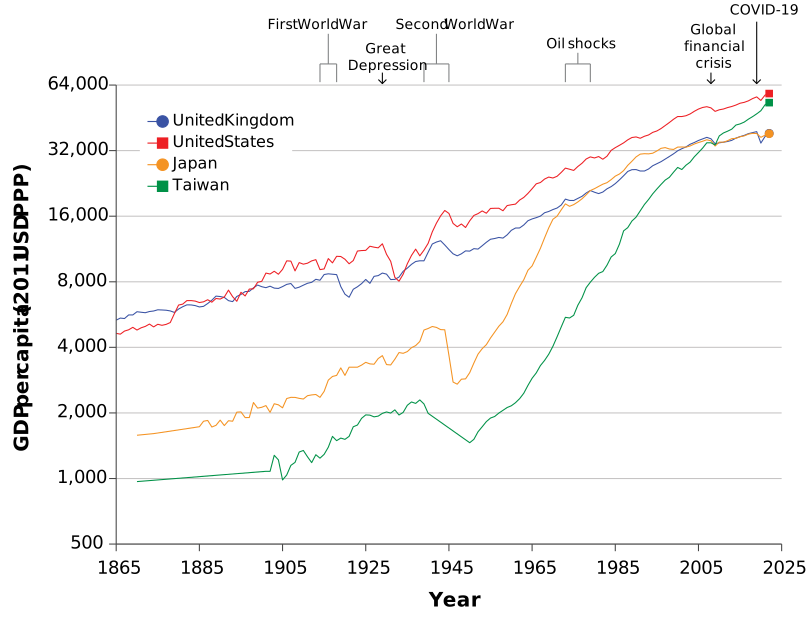
Figure 9.6a Technological leaders, catch-up growth, and convergence, 1865–2023.
Jutta Bolt and Jan Luiten van Zanden. 2024. ‘Maddison-Style Estimates of the Evolution of the World Economy: A New 2023 Update’. Journal of Economic Surveys: pp. 1–41.
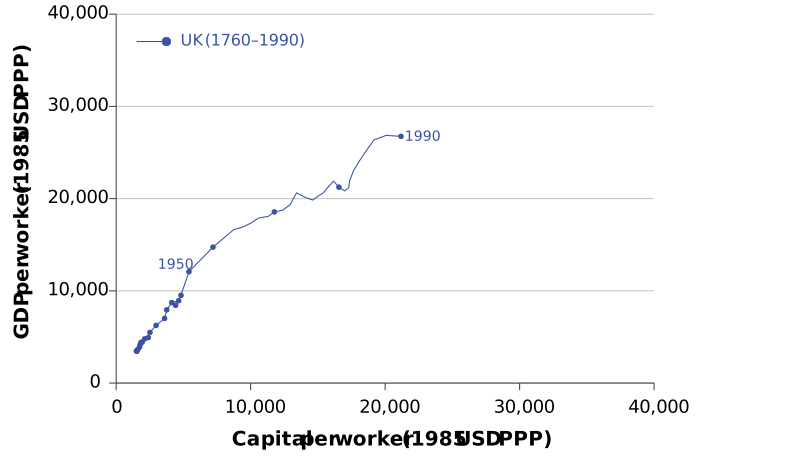
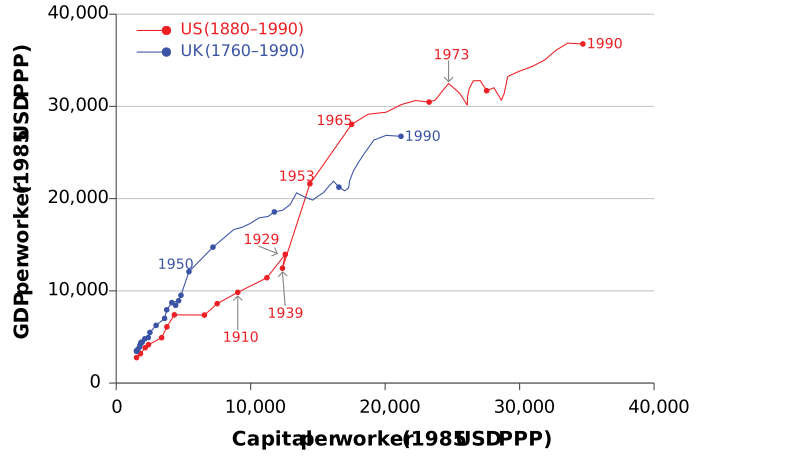
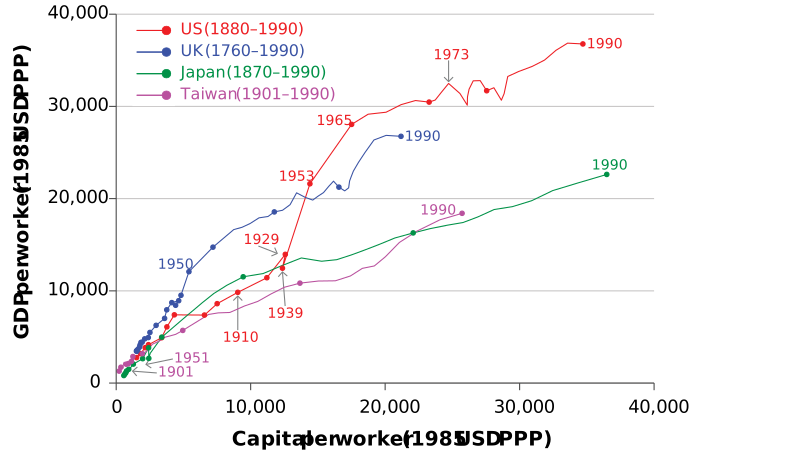
Figure 9.6b shows the relationship between output per worker and capital per worker, in the same countries for comparison with the model in Figure 9.5.
Focusing first on Britain, the figure shows the path traced out over time as both capital intensity and productivity rose, beginning in 1760 (the bottom corner of the chart) and ending in 1990 with output per worker more than seven times as high. In the US, productivity overtook the UK by 1910 and has remained higher since. In 1990, the US had higher productivity and capital intensity than the UK.

Figure 9.6b Long-run growth trajectories of selected economies, 1760–1990.
Robert C. Allen. 2012. ‘Technology and the Great Divergence: Global Economic Development Since 1820’. Explorations in Economic History. 49(1): pp. 1–16. Note: the dots refer to decadal data unless otherwise indicated.
The United Kingdom
The United States
Japan and Taiwan
John Habakkuk, an economic historian, has argued that wages were high for factory workers in the US in the late nineteenth century because they had the option to move to the west of the country where they could readily become farmers owning their own land: in response to the high wages, the factory owners had the incentive to develop and install labour-saving technology.
Figure 9.6b shows that the economies that are rich today have had their labour productivity (output per worker) rise over time as they became more capital-intensive. For example, if we consider the US, capital per worker (measured in 1985 US dollars) rose from $4,325 in 1880 to $14,407 in 1953, and $34,705 in 1990. Alongside this increase in capital intensity, US labour productivity rose from $7,400 in 1880 to $21,610 in 1953, to $36,771 in 1990.
Now consider Japan and Taiwan. By 1990, capital per worker in Japan was not only higher than in the US, but also almost twice as high as in Britain. Japan had reached this level in less than half the time it took Britain to do so. Taiwan in 1990 was also more capital-intensive than Britain. The lead in mass production and science-based industries that the US had established was eroded as other economies invested in education and research, and adopted American management techniques.1
In contrast to the model in Figure 9.5, which shows the shift in the production function and an increase in capital intensity separately, the data in Figure 9.6b combines both effects. In the model, the effect of the increase in \(K/N\) on its own is to reduce the average product of capital (APK), which is partially offset by the upwards rotation of the production function. This is why the historical data graphs in Figure 9.6b are less curved (less concave) than the ones we drew in Figure 9.5.
Interpreting Figure 9.6b using the model of the production function in Figure 9.4 shows that all the economies adopted more capital-intensive methods of production as they became richer. However, while Japan and Taiwan both experienced substantial technological progress, the fact that output per worker at each level of capital intensity remained below that of both the US and Britain means that they remained on a lower production function.
To summarize:
- The increase in the amount of capital goods per worker contributes to increases in the output per worker, which permits increases in living standards.
- Technological progress rotates the production function upwards, stimulated by the prospect of innovation rents.
- This partially offsets the diminishing average returns to capital that would otherwise limit the accumulation of capital.
Question 9.2 Choose the correct answer(s)
Read the following statements about a production function with a constant returns technology \((Y = z F(K, N))\) and choose the correct option(s).
- With a constant returns technology, to double the output, the number of machines (\(K\)) must also double.
- Based on the definition of the function, output will increase in proportion to \(z\).
- Technological improvement rotates the production function, so it still exhibits a diminishing average product of capital. However, the average product of capital at each point on the function is now higher.
- Technological improvement rotates the production function, so the average product of capital at each point on the function is now higher.
Exercise 9.3 Explaining technological progress for the United States
Figure 9.6b shows how GDP per worker and capital per worker changed over time for the US. Using the article ‘The Rise and Fall of American Technological Leadership: The Postwar Era in Historical Perspective’ by Richard Nelson and Gavin Wright, explain why the US became a technological leader in the twentieth century. In your answer, use the following concepts:
- the production function (shift along and shift of)
- labour-saving technology
- innovation rents
- research and development
- education and competition.
Extension 9.3 The production function and the return to investment in capital
In the main part of this section, we discussed the implications for output growth of diminishing capital productivity, as measured by the average product of labour. In this extension, we introduce another measure of productivity—the marginal product—and use calculus to investigate the properties of the production function under constant returns. In particular, we prove that both the average and marginal products diminish with capital intensity. We use these properties to show how output growth can be sustained through the combination of investment in capital goods and technological progress.
As in the main part of this section, we write the production function as:
\[Y = z F(K, N)\]where \(K\) and \(N\) are capital and labour, and \(z\) represents the current state of technology.
Average and marginal products
Both labour and capital goods contribute to the production of output. One way to measure how productive they are is average productivity—that is, how many units of output are produced for each unit of labour used, and similarly for capital goods:
\[\text{Average product of labour (APL)} = \frac {Y}{N} = \frac{z F(K,N)}{N}\] \[\text{Average product of capital (APK)} = \frac {Y}{K} = \frac{z F(K,N)}{K}\]In general, the APL and the APK each depend on both \(K\) and \(N\): typically, for example, if \(K\) increases while \(N\) remains constant, the APL will increase (workers are more productive when each one has more capital to work with). Conversely, if \(N\) increases while \(K\) is fixed, the APL will fall (because each worker has less capital to work with).
We can also measure the marginal productivity of \(N\) and \(K\): that is, the rate at which output increases in response to a small increase in one of the inputs. Like other marginal quantities (for example, marginal cost) the marginal products can be calculated using calculus, by taking the partial derivative:
\[\text{Marginal product of labour (MPL)} = \frac {\partial Y}{\partial N} = \frac{z \partial F(K,N)}{\partial N}\] \[\text{Marginal product of capital (MPK)} = \frac {\partial Y}{\partial K} = \frac{z \partial F(K,N)}{\partial K}\]We often analyse production functions under the assumption that, although there may be two or more inputs, only one of them—typically labour—can vary. Then, as shown in Extensions 2.4 and 5.4 of the microeconomics volume, we can draw a graph to show how output increases with labour while the other inputs remain fixed; at each point on the function, the MPL is the slope of the function, and the APL is the slope of a ray from the origin to the function. We make the same assumption in Units 1 to 4: aggregate output depends only on employment, because the capital stock is assumed to be fixed in the short run.
Modelling output growth, with constant returns to scale
- constant returns to scale
- When production exhibits constant returns to scale, increasing all of the inputs to a production process by the same proportion increases output by the same proportion. The shape of a firm’s long-run average cost curve depends both on returns to scale in production and the effect of scale on the prices it pays for its inputs. See also: increasing returns to scale, decreasing returns to scale.
To explain how output grows in the long run, we need to allow other inputs—not just labour—to change. But we can simplify the analysis by making the important assumption that the production process has constant returns to scale—that is, if all inputs are increased by the same proportion, then output also increases by that proportion. For the production function \(Y = z F(K, N)\) we can express the constant returns property by saying that for any positive number, \(\lambda\):
\[F(\lambda K, \lambda N) = \lambda F(K,N)\]It is often reasonable to assume constant returns to scale, provided we have allowed for all of the inputs. To see why this matters, suppose that the production of grain actually requires three inputs: capital goods, labour, and land. If we were to double the amounts of all three inputs, it is plausible to argue that output would double: effectively, we could produce twice as much grain with two identical farms. But if we were analysing production on a particular farm, we might ignore the amount of land because it always remains fixed, and write output as a function of capital and labour. Then, doubling labour and capital would not double the output, because the land would have to be used more intensively.
To illustrate the implications of constant returns, we will focus on a particular type of function. The Cobb–Douglas production function with constant returns to scale in capital and labour takes the form:
\[Y= zF(K,N)= zK^{b}N^{1-b}\]where \(b\) is a constant between 0 and 1. To confirm that this has constant returns:
\[\begin{align*} F(\lambda K, \lambda N) &= (\lambda K)^{b}(\lambda N)^{1-b} \\ &= \lambda^{b} K^{b}\lambda ^{1-b}N^{1-b} \\ &=\lambda^{b}\lambda^{1-b}K^{b}N^{1-b} \\ & =\lambda F(K,N) \end{align*}\]As discussed in the main part of this section, output per worker is a function of capital intensity only (with technology, \(z\), held constant):
\[\text{Output per worker} = \frac{Y}{N} =zK^{b}N^{-b}=z\left(\frac{K}{N}\right)^b\]This property means that output per worker is the same function of capital intensity, whatever the number of workers. So it allows us to capture the features of the production function in a simpler equation than the one we started with. Writing \(y\) for output per head \(Y/N\) and \(k\) for capital intensity \(K/N\), the equation for output per head is:
\[y = zk^b\]Furthermore, since \(Y=Ny\), and \(K=Nk\), the ratio of \(Y\) to \(K\) is the same as the ratio of \(y\) to \(k\), whatever the value of \(N\). So the average product of capital is given by:
\[\text{APL} = \frac{Y}{K}= \frac{y}{k} = zk^{b-1}\]Likewise, the ratio of a change in \(Y\) to a change in \(K\) is equal to the ratio of the corresponding changes in \(y\) and \(k\). The marginal product of capital is:
\[\text{MPK} = \frac{\partial Y}{\partial K} = \frac{dy}{dk} = bzk^{b-1}\]Figure E9.1 (similarly to Figure 9.4) shows the graph of output per worker \(y\) as a function of \(k\), and the average and marginal products of capital at points A and B. At each point, the APK is \(y/k\), the slope of the ray to the origin, and the MPK is \(dy/dk\), the slope of the curve.
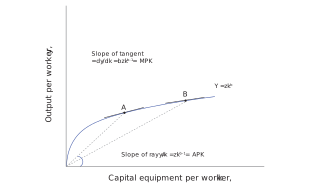
Figure E9.1 The Cobb–Douglas production function in per-worker terms.
Diminishing average and marginal products
In Figure E9.1, the average product of capital is diminishing, and the marginal product diminishes too: both APK and MPK decrease as capital intensity rises. We can verify this from the algebraic expressions: \(\text{APK}=zk^{b-1}\), which decreases as \(k\) rises:
\[\frac{d\text{APK}}{dk}=(b-1)zk^{b-2}<0 \text{ since }b<1\]and similarly for the MPK.
Also, \(\text{MPK} = b\text{APK}\), which confirms that the marginal product is always less than the average product—the tangent is flatter than the ray.
Economic implications
Using an aggregate production function with constant returns to scale in labour and capital, the analysis in per-worker terms helps us to understand why investment in capital equipment may not be sufficient on its own for output growth. As discussed in the main section, investing to increase capital per worker will raise output, but capital productivity as measured by the average product (APK) will fall.
- opportunity cost of capital
- The opportunity cost of capital is the amount of income an investor could have received, per unit of investment spending, by investing elsewhere.
We now know that the marginal product of capital also diminishes as k increases, and this is important because it helps to explain how much investment we can expect to occur. If the marginal product of capital goods falls, further increases in \(k\) will add less and less to output. This means that the return to investing in capital goods will fall. If the return falls below the opportunity cost of capital—the benefit that investors can expect from alternative uses of their funds—they will have no incentive for further investment.
Figure E9.2 illustrates how growth can occur, as a result of technological progress. Suppose that the economy is in equilibrium at point A: at this level of capital per worker, the return to investment—represented by the marginal product at A—is equal to the opportunity cost of capital. Investors will not be willing to fund a higher level of \(k\), because the return further along the production function would be too low. Now suppose technology (\(z\)) improves, rotating the production function upwards. At the current level of capital goods per worker, the marginal product is now higher—the return to investment at point A′ is above the opportunity cost of capital. So investment rises, and the economy grows along the new production function. As \(k\) increases, the MPK falls. Growth will continue until the return on investment is again equal to the opportunity cost of capital.
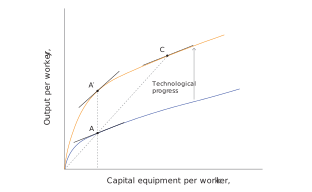
Figure E9.2 The Cobb–Douglas production function: an improvement in technology.
Figure E9.2 is drawn for a Cobb–Douglas production function (with \(b = \frac{1}{2}\)). In this case, growth continues as far as point C. To understand why, note first that C is on the same ray from the origin as A, which means that the APKs at points C and A are equal. From \(\text{MPK}=b\text{APK}\), we know that the MPKs are also the same at the two points. So if the MPK is equal to the opportunity cost of capital at A, C is the point where the return on investment in capital has fallen back to equal the opportunity cost again.
Now imagine the effect of continuous technical progress: that is, a steady rise in \(z\) over time. As the technology improves, higher returns to investment lead to a steady increase in capital intensity, with output increasing in proportion, maintaining a constant average product of capital. In Figure E9.2, the economy grows along the ray from the origin through A and C, on which both the APK and MPK remain constant. A Cobb–Douglas production function combined with technological progress has constant returns to capital intensity, enabling steady continuous growth over time.
Exercise E9.1 Returns to scale, average product, marginal product
For each of the following functions, determine whether it has constant returns to scale, and calculate the APK and MPK:
- \(F(K, L) = 5K + 2L\)
- \(F(K, L) = 3 K^0.7 L^0.5\)
- \(F(K, L) = A \left(K^2 + L^2 \right)^{1/2}\), where \(A\) is a constant
- \(F(K, L) = A e^{4K + 7L}\), where \(A\) is a constant
- \(F(K, L) = 6 \log(K) + \log(L)\)
-
Richard R. Nelson and Gavin Wright. 1992. ‘The Rise and Fall of American Technological Leadership: The Postwar Era in Historical Perspective’. Journal of Economic Literature 30(4): pp. 1931–1964. ↩
