
Unit 9 Uneven development on a global scale
9.8 How poor countries get stuck at low growth and how they can grow rapidly
The simple grain-only economy of Section 9.5 helps us to understand what can set off a process of sustained growth of per capita output in an economy, which can take it from low- to middle- or high-income levels. We highlighted there that a windfall harvest provides resources for investment that do not require a fall in consumption. We can generalize the insight that saving enough to expand the level of capital per worker (whether imposed by governments or chosen by households) is more likely to be sustainable when it does not entail reduced current consumption. Reasons relate both to individual psychology and political processes.
Another mechanism through which higher investment can arise without a simultaneous fall in average consumption is through changes in institutions that result in a shift in the distribution of income away from landlords and other elites who save and invest in assets (such as palatial houses and monuments), to capitalists who have to invest in order to survive the competition with other capitalists. The rate of growth in European economies in the late eighteenth and early nineteenth century is thought to have increased in part due to institutional changes of this kind, resulting in a shift in what wealthy people did with the resources at their command. Prior to 1700, the largest buildings in many European towns were churches; after 1800, the largest buildings were factories.
The growth dynamics model
- growth dynamics model
- A growth dynamics model is an economic model of the process by which a variable changes (grows) over time, in which the growth rate in one period depends in a systematic way on the growth rate in previous periods.
- exogenous growth
- Growth in aggregate output (GDP) which occurs as a result of independent, unintentional effects such as ‘learning by doing’. This contrasts with endogenous growth, which occurs as a result of intentional actions by economic agents.
- endogenous growth
- Growth in aggregate output (GDP) which occurs as a result of intentional actions by economic agents, such as investment to raise the capital stock, or R&D to develop a better production process. This contrasts with exogenous growth, which occurs as a result of unintentional effects such as ‘learning by doing’.
In this section, we build on the grain economy model in Section 9.5, but we drop the simplifying assumption that output increases at a constant rate with capital (grain planted), to allow for more general technologies. As before, there is a single good (grain) that is produced, consumed, and invested in by a fixed population of farmers. We will develop a model that distinguishes between two sources of growth—exogenous growth and endogenous growth. And we will explain why we call it the growth dynamics model.
Exogenous growth happens irrespective of the investment decisions made by the farmers. Suppose, for example, that independently of the level of investment, output can be increased by learning and adopting better ways to produce, which we call learning by doing and from others. Perhaps farmers find out from experience (or from observing neighbouring farms) that planting a bit earlier in the spring yields a larger harvest. Exogenous growth is often labelled as ‘technological change’, but it should be thought of much more broadly because it will reflect not only advances in technology but also the institutional framework of the economy. Whether or not new ways of doing things are readily shared and spread across the economy depends on the nature of intellectual property rights and practices, the level and nature of schooling, and the organization of the production process.
Endogenous growth arises through the decisions of farms to invest some of their grain as capital, to raise future output.
To understand how exogenous and endogenous growth combine, we can use the growth accounting equation, which relates the rate of growth of output to the growth rates of the inputs to production and technological progress (explained in Section 9.4). Output growth, \(g^Y\), is the sum of technological progress, \(g^z\), and a weighted average of the growth rates of the inputs. Here we interpret \(g^z\) more widely as exogenous growth, to include learning by doing. In the grain model, the inputs are capital and labour, but the number of farmers does not change (\(g^N = 0\)), and so we can write:
\[g^Y = g^z + \beta g^K\]where \(g^K\) is the endogenous growth rate of the capital stock. The parameter, \(\beta\), captures the effect on output of net capital investment.
To model net investment, we pick up the idea introduced in Section 9.5 that higher growth in this period (from a bumper harvest, for example) provides the resources for increasing the capital stock without decreasing consumption. This means that investment contributes to growth but, in addition, growth contributes to investment.
Specifically, we assume that net investment is proportional to last year’s output growth rate. So if \(g_t\) is the growth rate from year \(t-1\) to year \(t\), the growth in the capital stock from year \(t-1\) to year \(t\) is given by:
\[g^K_t = \alpha g^Y_{t-1} \text{where } \alpha > 0\]In this equation, \(𝛼\) (the Greek letter, alpha) is the fraction of last year’s growth that is invested. To understand this investment rule, suppose for example that \(𝛼 = 0.75\). If output had increased by 4% last year, from 100 to 104 units, and last year’s capital stock was 40 units, the investment rule tells you to increase the capital stock by 3%, from 40 to 41.2 units. You would use 1.2 units of the extra output for net investment (in addition to what is required to allow for depreciation), and the other 2.8 units for extra consumption.
Substituting the investment rule into the equation for the growth of output, we can show that this year’s growth rate, \(g^Y_t\), depends on the exogenous growth rate, \(g_z\), and last year’s growth rate:
\[g^Y = g^z + \alpha\beta g^Y_{t-1}\]More precisely, this relationship captures what we expect the growth rate to be in year \(t\), given the investment resulting from the previous year’s growth. Unexpected weather conditions could result in a higher or low harvest than predicted.
- growth dynamics curve
- The growth dynamics curve is a graph of the relationship between the growth rate in period \(t\) (on the horizontal axis) and the growth rate in period \(t+1\) (on the vertical axis). A point where the graph crosses the 45-degree line represents an equilibrium growth rate: once the economy reaches this rate of growth, it will remain there unless there is an unexpected shock.
- price dynamics curve
- The price dynamics curve is a graph of the relationship between the price of a good in period \(t\) (on the horizontal axis) and the price in period \(t + 1\) (on the vertical axis). A point where the graph crosses the 45-degree line represents a market equilibrium: at this price demand = supply so the price stays constant from one period to the next. At other prices excess demand or excess supply leads to a change in price.
The growth dynamics curve describes how growth rates change from period to period, just as the price dynamics curve in Unit 8 describes how prices change from one period to the next.
We will assume that \(𝛼\), \(𝛽\), and \(g_z\) are all positive constants. Figure 9.17a shows this relationship between growth rates in two successive years graphically. We call this relationship the growth dynamics curve, although in this model it is a straight line with a slope of \(𝛼𝛽\). Considering point A first, if growth in period 0 is close to zero, the expected growth rate in period 1 is only just above the exogenous growth rate, \(g_z\). Point B illustrates how high growth in period 0 leads to high growth in period 1 as well, because it stimulates investment.
The growth dynamics curve in Figure 9.17a is drawn for the case, \(𝛼𝛽 < 1\), which means that it crosses the 45-degree line. Work through the steps to understand why there is a stable equilibrium growth rate at the crossing point.
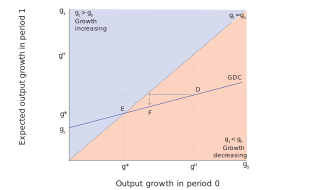
Figure 9.17a The growth dynamics model.
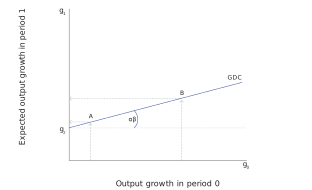
The growth dynamics model: the growth dynamics curve and the equilibrium growth rate
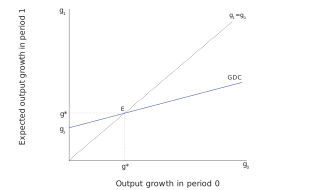
When (𝛼𝛽 < 1)
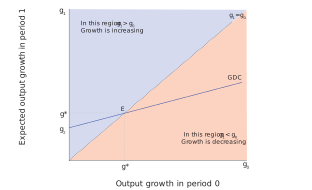
Growth above and below the 45-degree line
Growth following a one-off positive economic shock
Figure 9.17a illustrates a stable growth equilibrium. Although the economy may temporarily experience periods of higher or lower growth, it will always tend to return to a steady growth rate equal to \(g^*\).
Raising the equilibrium growth rate
If the equilibrium rate, \(g^*\), is low, this economy is stuck in a low-growth trap. An occasional good harvest or other source of an increase in income does not last, and growth returns to the equilibrium rate.
To shift from a low-growth trap with low GDP per capita to one in which the economy grows rapidly year after year, to reach a substantially higher level of GDP per capita—as observed in the hockey stick charts—the equilibrium rate of growth must be higher, at least for a time. And this in turn requires changing how the economy works, as represented in the model by \(𝛼\), \(𝛽\), and \(g_z\). Therefore, a policy that aims to sustainably raise incomes in a country would aim to raise one or more of these variables.
In the aggregate economy the fraction, \(𝛼\), of growth that is invested could be increased by:
- wealthy private individuals choosing to consume less (for example on luxuries) and instead invest some of their increased income to construct privately owned capital goods—for example, building factories and not palatial mansions, as happened in the eighteenth century; and in the twenty-first century, building data centres and not mega-yachts or resorts on private islands
- the financial system successfully facilitating the investment of an increase in saving in the economy (as discussed in Unit 6)
- a government devoting more tax revenues to building infrastructure (for example, roads and education)
- forms of redistribution that incentivize the accumulation of productive capital goods.
Factors that increase \(𝛽\), the benefit to growth of additional investment, include the quality of institutions, infrastructure, and schooling. Figure 9.17b shows how a rise in \(𝛼\) or \(𝛽\) (or both) would change the slope of the growth dynamics curve, and hence raise the equilibrium growth rate.
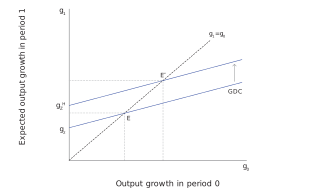
Figure 9.17b Modelling an increase in growth rates.
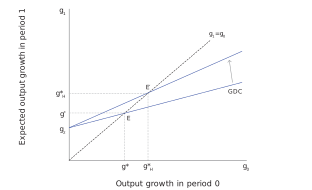
The growth dynamics model: raising the equilibrium growth rate
Raising the exogenous growth rate
The second step in Figure 9.17b shows that higher exogenous growth also raises the equilibrium growth rate. This could come about, for example, if a better educated or more cooperative population were willing to share knowledge, increasing the rate of learning by doing.
Disequilibrium growth
If the policymaker succeeded in raising \(α\) or \(β\) sufficiently such that \(αβ > 1\), the growth process would take a completely different form, as illustrated in Figure 9.17c. There is no equilibrium rate of growth because the slope of the growth dynamics curve is greater than the slope of the 45-degree line. The growth dynamics curve lies in the region where growth is increasing. So a high growth rate in one period leads to an even higher one in the next period.
If growth in period 0 is \(g′\), in the next period it will be higher (\(g″\)), and in the following period higher still. Growth increases (output accelerates) from period to period.
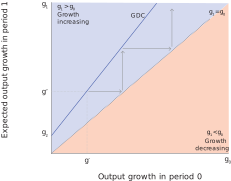
Figure 9.17c When \(αβ > 1\), growth increases indefinitely.
Although in the real world, growth cannot go on increasing indefinitely, the model can be extended to be more realistic by combining a phase of disequilibrium growth with equilibrium growth to produce an S-shaped growth dynamics curve (like the models in Unit 8). The S-shaped model incorporates a negative feedback process around two equilibria, one at low and one at high growth. Between them is an unstable equilibrium (the tipping point), where the growth dynamics curve (GDC) has a slope greater than one. Explosive growth is dampened in the S-shaped model. The model is explained in the extension.
Exercise 9.10 The growth dynamics model: Numerical examples of the growth dynamics curve
- Using the equation for the growth dynamics curve (\(g^Y = g^z + \alpha\beta g^Y_{t-1}\)), draw a growth dynamics curve diagram for the following scenarios:
- \(g_z = 4\%, \alpha = 0.7, \beta = 0.5\)
- \(g_z = 2\%, \alpha = 0.3, \beta = 0.6\)
- For each scenario, calculate and label the equilibrium growth rate on your diagrams from Question 1. For each scenario, which value(s) of \(\alpha\) would make growth stable, and which values of \(\alpha\) would make growth unstable?
- If the economy starts on the GDC with an initial growth rate (\(g_0\)) of 5%, use your diagrams from Question 1 to indicate what happens to economic growth in the next three years. Make sure to label the coordinates for each point.
Extension 9.8 Models of economic growth
In the main part of this section, we used diagrams to explain the growth dynamics model (GDM). In this extension, we analyse the model algebraically before extending it to the case of an S-shaped growth dynamics curve, leading to multiple equilibria. Finally, for readers familiar with the Solow growth model, we explain the relationship between the Solow and GDM models.
The linear growth dynamics model (LGDM)
The model analysed in the main part of this section is based on two equations. Output is produced using capital and labour. The growth accounting equation describes the relationship between the growth rate of output (\(g^Y\)) and the growth rates of the inputs, allowing for technological progress at exogenous rate, \(g^z\). Since the labour input is fixed, the growth rates in period \(t\) satisfy:
\[g^Y_t = g^z + \beta g^K_t\]To remind yourself how to derive the growth accounting equation from the production function, refer back to Extension 9.4. The derivation is for the continuous-time version, but we can use the same equation for the growth dynamics model because it is approximately true in discrete time.
where \(g^K\) is the endogenous growth rate of the capital stock. We assume that the weight \(\beta\) is a constant, which is the case for a Cobb–Douglas production function.
The second equation is the investment rule:
\[g^K_t = \alpha g^Y_{t-1}\]where \(\alpha\) is a positive constant. Combining the two gives the growth dynamics curve (GDC), which, since \(\alpha\) and 𝛽 are both constant, is a linear relationship between output growth in successive periods:
\[g^Y_t = g^z + \alpha\beta g^Y_{t-1}\]In the main part of this section, we analysed the behaviour of the growth rate graphically, by plotting this relationship. In this extension, we demonstrate how to analyse the model algebraically.
Finding the equilibrium growth rate
Depending on the values of \(\alpha\) and \(\beta\), the economy may have an equilibrium growth rate \(g^*\), such that if the growth rate is \(g^*\) in one period, then it remains at \(g^*\) the following period, and in all subsequent periods until changed by a growth shock. If \(g^*\) exists, it satisfies:
\[\begin{align*} g^* &= g^z + \alpha \beta g^* \\ \Rightarrow g^* &= \frac{g^z}{1 - \alpha \beta} \end{align*}\]from which we can infer that a (positive) equilibrium growth rate exists if, and only if, \(\alpha\beta<1\).
Dynamics and stability
To analyse the dynamic behaviour of growth, we first consider the case when \(\alpha\beta<1\). Then an equilibrium exists, satisfying \(g^* = g^z + \alpha\beta g^*\). We can subtract this equation from the equation for growth in successive periods (\(g^Y_t = g^z + \alpha\beta g^Y_{t-1}\)) to obtain:
\[g^Y_t - g^* = \alpha \beta (g^Y_{t-1} - g^*)\]which tells us that how far the growth rate is from \(g^*\) in period \(t\) depends on how far away it is in the previous period. From this equation, we can deduce that:
- If \(g^Y_{t-1}\) is above \(g^*\) then so is \(g^Y_t\) , but \(g^Y_t\) is closer to \(g^*\).
- If \(g^Y_{t-1}\) is below \(g^*\) then so is \(g^Y_t\) , but \(g^Y_t\) is closer to \(g^*\).
Hence the growth rate converges towards \(g^*\): the equilibrium is stable. This is the case illustrated in Figure 9.17a.
Now consider the case when \(\alpha \beta >1\), when there is no equilibrium growth rate. To analyse how growth changes from period to period, first note that provided that growth is positive or zero in period \(t-1\), it will increase in the following period:
\[\text{If } g^Y_{t-1} \geq 0, ~ g^Y_t - g^Y_{t-1} = g^z + (\alpha \beta - 1) g^Y_{t-1} > 0\]Then, if we subtract the equation for the growth rate in period \(t\) (\(g^Y_t = g^z + \alpha \beta g^Y_{t-1}\)), from the equation for period \(t+1\) \((g^Y_{t+1} = g^z + \alpha \beta g^Y_t)\), we find that growth increases more in period \(t+1\):
\[g^Y_{t+1} - g^Y_t = \alpha \beta (g^Y_t - g^Y_{t-1}) > g^Y_t - g^Y_{t-1}\]We can conclude that if growth is ever positive or zero, the growth rate will increase from period to period, indefinitely.
The S-shaped growth dynamics model (SGDM)
We have analysed a version of the growth dynamics model in which the fraction of growth invested (\(\alpha\)), and the effect on output of net capital investment (\(\beta\)) are fixed constants, irrespective of what is happening in the economy. In that case, the growth dynamics curve is a straight line with slope \(\alpha\beta\). We will now extend the model to provide a more realistic picture of growth dynamics by assuming that \(\alpha\) and \(\beta\) can vary: in particular, suppose that the investment fraction \(\alpha\) depends on investors’ expectations about future growth. In this version, the GDC is S-shaped (as in the model developed in Section 8.5 for the dynamics of house prices), and there are both low-growth and high-growth equilibria.
Negative and positive feedback processes
Imagine an economy at an equilibrium like the one illustrated in Figure 9.17a, with a low equilibrium growth rate. This is the case \(\alpha\beta < 1\), where \(\alpha\) is the fraction of growth invested, and \(\beta\) is the effect on output of net capital investment. The left panel of Figure E9.3 illustrates the process of negative feedback that keeps the economy stuck in a low-growth trap. Suppose that a positive shock in one period raises growth above the equilibrium level. Increased investment means that growth is also above equilibrium in the next period, but since \(\alpha\beta < 1\), it is lower than in the first period. Everyone expects growth to return to the equilibrium level over the next few periods; hence \(\alpha\) and \(\beta\) do not change, and growth does return to that level.
However, as shown in the right panel, the positive shock to growth can itself change expectations about future growth, which produces a positive feedback process through an increase in \(\alpha\) or \(\beta\), or both. Once growth is ‘high enough’, the momentum reinforces itself. This could happen, for example, if the owners of firms observe other firms growing strongly and believe that this will boost the growth of the market for their output (they believe \(\beta\) will rise). They are spurred on both by the ‘carrot’ of more rapidly growing profits and the ‘stick’ of increasing competition from the growth of firms threatening their market share to increase capital investment (so \(\alpha\) rises).
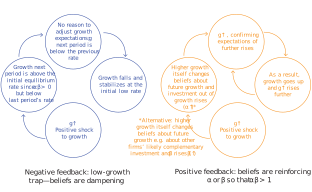
Figure E9.3 Negative and positive feedback in growth dynamics.
Equilibria with an S-shaped growth dynamics curve
We can incorporate both negative and positive feedback processes into a growth dynamics model using an S-shaped GDC, as shown in Figure E9.4. As in the main part of the section, we put the growth rates in period \(t\) and period \(t+1\) on the horizontal and vertical axes; the GDC is the relationship between them. We also draw the 45-degree line along which growth is stable from period to period.
There are now three equilibrium rates of growth, at A, B, and C. At points B and C, the GDC is flatter than the 45-degree line \((\alpha\beta < 1)\), so these equilibria are stable like the one in Figure 9.17a. If the economy is at either of these equilibria, a growth shock will be followed by a negative feedback process that restores the equilibrium. An economy at C is stuck in a low-growth equilibrium; at B, the feedback process sustains a high-growth rate.
But at intermediate levels of growth the slope \(\alpha\beta\) of the GDC is greater than 1. There is an equilibrium at A: if growth reaches this level, it will remain there until disturbed by a shock. But this equilibrium is unstable: a shock, however small, will be followed by a positive feedback process like the one in Figure 9.17c. A positive shock that raises growth in one period will be followed by higher growth in the following one. Growth will increase from period to period along the GDC, as in Figure 9.17c. The difference here is that this doesn’t go on for ever; as the growth rate rises investors change their expectations of future growth, so \(\alpha\) and \(\beta\) adjust. Eventually the GDC gets flatter again, and the economy converges to the high-growth equilibrium at B.
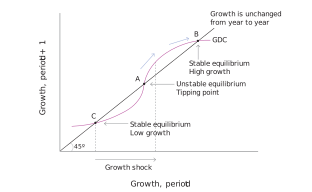
Figure E9.4 Multiple equilibria in the S-shaped model.
The unstable equilibrium at A is a tipping point. If the growth rate is above the level at A, it will increase along the GDC until the high-growth equilibrium at B is achieved. But from any point below A, the growth rate will fall in successive periods until the low-growth equilibrium at B is reached. This means that an economy stuck in a low-growth equilibrium can escape—but only following a large positive shock that takes it beyond the tipping point.
Read Section 8.6 for a more detailed discussion of a shift in the price dynamics curves in the analogous case of house prices. Note, however, that the example discussed there is a downward shift.
However, an exogenous rise in \(\alpha\), \(\beta\) or \(g^z\) could shift or rotate the GDC upwards, bringing the tipping point closer to the low-growth equilibrium, so that the low-growth equilibrium and the tipping point were closer together. Then the escape from a low-growth trap would be easier; a much smaller positive shock would enable the economy to begin the transition to the high-growth equilibrium.
Exercise E9.3 An upward shift in the growth dynamics curve
- Redraw Figure E9.4 to illustrate (i) an upward shift in the GDC, and (ii) an upward rotation in the GDC. Describe what happens to the position and number of equilibria.
- Give examples of exogenous changes in \(\alpha\), \(\beta\), and \(g^z\) that could cause an upward shift or rotation of the GDC.
A note about the relationship between the linear growth dynamics model and the Solow model
This subsection is intended for readers who are familiar with the Solow growth model, and may want to understand its similarities and differences from the growth dynamics model introduced in the main part of this section.
A widely studied model of growth, developed by economist Robert Solow in the 1950s, is based on the same constant returns production function that we have used in this unit. There are different versions of the Solow model: it can allow for exogenous rates of population growth, depreciation of the capital stock, and/or technological progress. To make a direct comparison between the Solow growth model and our model of growth dynamics, we assume that the production function is Cobb–Douglas with constant returns to capital and labour \((Y=zK^\beta L^{1-\beta})\), and focus on the version of the Solow model in which the labour force is fixed, there is no depreciation, and technology \(z\) (total factor productivity) grows exogenously at rate \(g^z\).
The essential difference between the two models is that they assume different investment rules:
- The Solow model assumes that gross investment is a constant proportion, s, of output. So with no depreciation, the increase in the capital stock is:
- We assume in the growth dynamics model that the growth rate of the capital stock is proportional to last period’s output growth rate:
Both are plausible assumptions about how investment is determined. Our choice was motivated by the hypothesis that output growth makes it easier to increase the capital stock because it provides resources for investment without the need to lower consumption.
Analysis of the two models demonstrates that both have a stable equilibrium growth rate \(g^*\):
- In the Solow model, \(g^*= \frac{g^z}{1-\beta}\). Both output \(Y\) and the capital stock \(K\) grow at rate \(g^*\), so the average product of capital \(Y/K\) (and hence also the marginal product) remains constant.
- In the linear growth dynamics model with \(\alpha\beta < 1\), \(g^* = \frac{g^z}{1-\alpha\beta}\). This is the same as the Solow growth rate if \(\alpha=1\), in which case capital and output grow at the same rate, so again \(Y/K\) remains constant. But if \(\alpha >1\), \(K\) grows faster than \(Y\), so \(Y/K\) decreases at the equilibrium growth rate; conversely if \(\alpha <1\), \(Y/K\) increases.
So in both the Solow model and the LGDM with \(\alpha = 1\), the economy grows as in Figure E9.2, along a ray from the origin. The difference is that in the Solow model the equilibrium average product of capital is determined by the savings rate: \(Y/K=g^*/s\); in the LGDM any level of \(Y/K\) can be maintained in equilibrium.
However, exactly the same equilibrium growth path can be achieved in both models by setting the parameter of the savings and investment rule. In the Solow model, the equilibrium value of the average product of capital can be chosen by setting the value of \(s\). In the LGDM, it can be chosen by varying \(\alpha\) dynamically: \(Y/K\) can be lowered by setting \(\alpha > 1\) so that the capital stock grows faster than output, or raised by setting \(\alpha < 1\), until the required value of \(Y/K\) is achieved; it can then be maintained by setting \(\alpha\) to 1 thereafter.
